Breakpoints

No Retina
Retina
XS Screen (480px)
SM+ Screen
SM Screen (768px)
SM- Screen
MD+ Screen
MD Screen (992px)
MD- Screen
LG+ Screen
LG Screen (1200px)
LG- Screen
XL+ Screen (1600px)
Author Image
Coaches Education
Author Location
Park City, UT

USSA Sport Education Coaches Tip of the Week: March 26 2013

By Coaches Education
March, 26 2013

Each week the USSA Sport Education Department will post a Coaches Tip of the Week.  The information will rotate through the ski and snowboard disciplines so check back each week to see the newest tip!

Mental Strength Training and Goal Setting
{This is an excerpt taken from the USSA Level 100 Cross Country Manual}

A coach must acknowledge their role as a teacher of mental skills, and should always be mindful of their influence on the psyche of the athletes they coach. In the example you set as a coach, in the words that you use to give feedback, in your body language, and in your day-today actions you are impacting mental skills. There are many specific areas of mental strength training that should be taught and practiced, but it is important to understand that in the mental game, the coach is constantly playing a role. How you interact with your athletes can impact their confidence, anxiety, focus, stress, and motivation. Work to understand what kind of impact you are having with each athlete, and find ways to make it the most positive.

Goal setting and performance planning are critical aspects of the Cross Country Training System performance psychology domain. Goal setting helps to organize and plan, so forward momentum is optimized.  Identification of short-term and long-term goals and achievement of those goals cultivates confidence and motivates the skier to continue to set further goals, perpetuating the journey.

The coach should look at goal setting as an integral element in the task of cultivating athlete motivation. Ultimately it is the athlete's internal motivation that will drive the effort they put forth. If the athlete is giving their full effort, effective coaching will bring about positive change. Without full effort and motivation, no matter how good the coaching, the athlete will not find great success. The coach must be mindful of their skier's motivation and use strategies that will maximize that motivation.
 

Mental Strength Training and Goal Setting (PDF copy)
 

Evaluate and Look Ahead

By Coaches Education
March, 20 2013

Most of the results from the season are now in the books. Successes against goals set are now being measured. It's a long season for the athletes. Their mental focus and physical energy can easily start to wane. This is an important time for coach, athlete and parent to reflect on the year and make a plan for the future. The athlete that came up short of their goals needs their coach's help to develop a plan that will drive the motivation to keep going. The athlete who had success needs guidance in setting new goals to continue to strive. An end-of-season evaluation helps facilitate this planning. It should be a cooperative process that both reflects on this season and looks ahead to next season.

A critical part of the evaluation process is completing a written evaluation form for each athlete. Here are some tips to make it happen and to make it effective.

Reflect and plan forward. Many end-of-season evaluations dwell on details of the season just completed, without or a lack of recommendations for the year ahead. What should the athlete do in the way of summer training? What program would be best suited for the athlete next season? What conditioning activities should the athlete focus on? What equipment needs should be addressed? Are there mental skills that can be worked on over the off-season? Think about how this season would have gone better if these specific questions were addressed from the season before? Make it easy for your athletes and their families to come into the next year better prepared.

Involve the athletes in the process. The evaluation form should be a record of things you have already discussed with your athletes. Their goals should be taken into account. The sidebar contains a fantastic example of a pre-evaluation letter to athletes and parents that sets the tone well for a productive season-end athlete/coach discussion. Be sure to schedule a meeting time to discuss the evaluation with your athletes, and their parents if appropriate. Make sure it is a two-way conversation. Ask the athletes the types of questions in the sample letter on the first page. This gives the athlete more ownership of the things you agree together will lead to improvement.

Use the USSA Training Systems model. Evaluations should be age-appropriate and based on the areas of emphasis highlighted in the USSA Training Systems. While the season-end evaluation may have a technical/tactical  and competition focus, be sure the other areas of emphasis (conditioning, equipment selection and preparation, performance psychology) are included. Track participation in training days and competitions with the recommendations for the athlete's phase in the Training System. Use the evaluation to explain how the athlete is doing related to their long-term development and potential.

Gear toward solutions, not deficiencies. The evaluation should not just point out athlete strengths and weaknesses. It should focus on the things the athlete can do about these areas over the summer and into the next season. Critically assess where the athlete is now and show where they can go. An effective athlete evaluation should lead to increased motivation and provide a path to focus the athlete's efforts. Even if the athlete didn't meet their goals, the evaluation should give them a positive outlook moving forward.

Many athletes tend to view their ability as fixed. This means to them that their results and rankings now are likely to continue into the future, regardless of what they do. This has dangerous implications both for those with great results and those who had a rough year. For these athletes, a negative evaluation without a focus on future opportunities may be the nail in the coffin of their career; or a positive evaluation without a focus on areas to improve may be an invitation to take it easy, allowing others to catch up. In reality, the performance evaluation is simply a snapshot in time that does not in itself pre-determine future performance. This is why an evaluation that has a long-term perspective with solutions that is discussed with each athlete is so important.

As powerful as the end-of-season evaluation can be, many USSA members said they did not receive an evaluation from their coaches at the end of the season in a recent survey. Most single day ski and ride school lessons end with a simple report card showing what was worked on and areas the student can work on. It not only helps the student improve, it increases the chance they'll be back for another lesson in the future. Yet many USSA club programs that spend a full winter with their athletes neglect this important step. It comes with a cost in terms of the athletes' developmental progress and possibly in their likelihood to return for another year. By spending the time to do a quality evaluation now, you are laying the groundwork for a better season next winter.

Click here for a downloadable copy for print.

USSA Sport Education Coaches Tip of the Week: Priming for Success

By Coaches Education
March, 7 2013

Priming For Competition
Jon Nolting, USSA Sport Education Director

The biggest competitions of the season are here and it is time for you as a coach to "prime" your athletes for success. Priming refers to putting athletes in a positive frame of mind for competition. One's belief in their ability to do something affects their abiliity to perform. Presumably, the entire season has been spent working on improving the ability of your athletes through technical and tactical training. To take advantage of this work, you must now put your primary focus on your athletes' belief in their abilities. Your feedback should now be directed at their strengths, helping them appreciate what they do well, and how that will help them at the big event.

U.S. Halfpipe Head Coach Mike Jankowski calls the final training block leading up to the championships a warm-up, implying that training is over, the work has been done, the athletes are ready. Training to achieve some last minute technical or tactical work likely won't become ingrained in time to be reliable for the upcoming event, and runs the risk of eroding confidence.

Think about your athletes as having their own confidence bank. Every criticism, even constructive feedback, is a withdrawal from the confidence bank. There is a time when it makes sense to make that withdrawal to invest in something for long-term gain, say skill development, but leading up to the championships is when the confidence bank should have its highest balance.

Fill the confidence bank account with specific praise. Former U.S. Ski Team men's head coach Bill Egan framed it this way: “If you belabor what the skier is deficient at too much you’re just going to neutralize the kid’s ability…you’re farting against thunder. One of the things you must do as a coach is you must get them to believe the things that they have that are really good are going to help them win.”

Think about these ideas leading up to major events to prime your athletes' mindset.

  • Forego the traditional timed runs race rehearsal the day before the competition and set a dual course. It encourages a high intensity approach that mirrors what you want in the competition and often increases the number of athletes who feel the day is successful since there are more chances for wins.
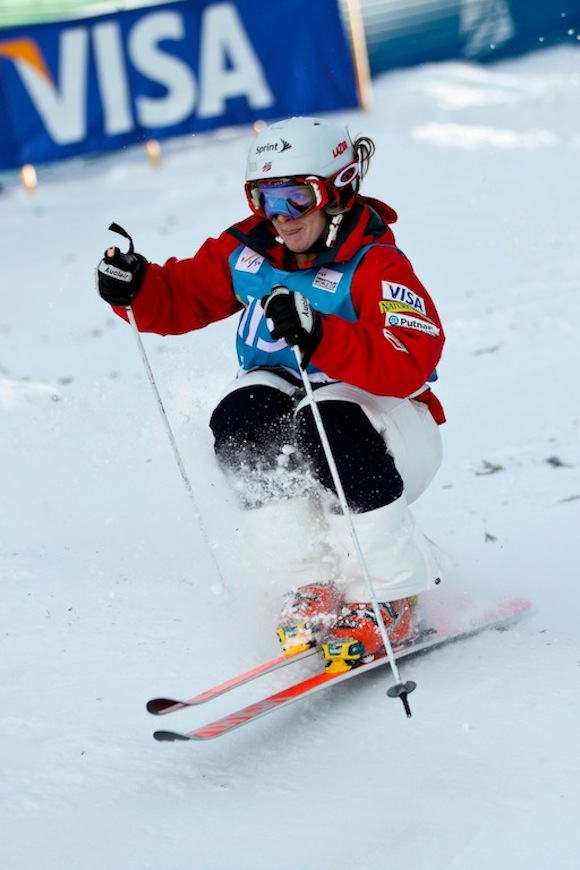
  • Make individual successes into team successes. Hannah Kearney's opening event gold medal in moguls at the 2010 Olympics primed the all the U.S. ski and snowboard teams for the successes they had the next two weeks. Kearney's success was a boost beyond just her freestyle teammates because all the skiers and riders were connected to her as Team USA athletes. Does your team atmosphere foster this type of connection and camaraderie across programs?
  • For video review at training sessions just before the big event, rather than watching and critiquing the runs that day, do video sessions watching the skier's/rider's best past performances, or watch inspirational footage such as World Cup or World Championships winning runs.
  • Make positive analogies during course inspection or before a competition run. For example, instead of saying "attack the course", say "attack the course like Ted Ligety". This connection with a successful person is important. It should invoke a powerful visual and positive state of mind. It is most effective if the athletes have a strong connection to that particular athlete. This can be fostered ahead of time by talking about things they have in common, whether it is their skiing or riding style, their interests, maybe even their birthday

PDF Copy of Priming for Competition

USSA Sport Education Coaches Tip of the Week: March 3, 2013

By Coaches Education
March, 4 2013

Each week the USSA Sport Education Department will post a Coaches Tip.  The information will rotate through the ski and snowboard disciplines so check back each week to see the newest tip!

Keeping it Simple: Teaching Cues in Mogul Skiing

Garth Hager, U.S. Ski Team Moguls Coach

"Keep it simple, coach." It is easy to say, but tough to practice. Each athlete learns in different ways. When assigning a new task or focus it is important to identify the most beneficial teaching method and the element of the skill that will be easiest to grasp for that particular athlete. This is where knowledge of how your athlete learns saves time and energy. Target what the athlete can feel, see, sense, or any other cue they respond to and apply the change.

Cues related to feel can be very powerful. If the athlete is unaware of the desired sensation, try to find it somewhere else. A good example of this is a mogul take off.  Quite a bit can happen as an athlete goes off of a mogul jump. To have them alter what they feel can be difficult if they dont already have awareness of the right feeling. For some it may be a blur. Here are a few ways to get athletes to be aware of their body position and feeling.

  • Make sure they can focus on the take off specifically. Start just a couple moguls before the take off to set up better and accomplish the skill or adjustment.
  • Slow down the process with a larger jump transition to allow more sensory feedback. Water ramps are generally twice as large as their on-snow counterpart. For mogul skiing, slowing down the process can allow the athletes to have more awareness of their position in the air.  If water ramps are not available, riding a jump slowly and visualizing or feeling the change may help show the "hard to pinpoint" task.  
  • Focus on the positioning before entering the transition zone or after the take off, with the hope of transfer of the skill to the desired area.

A good example is Hannah Kearney's back layout landing. "Drive" is her cue to reach downward with her hands at the flat belly position and continue through landing. She drives her arms and hands towards the exit path while skiing direct. She understands this one word to mean a whole feeling through her jump and exit. At the 2010 Olympic Winter Games it was her attitude for her winning run to ski aggressively and "drive" her path to the bottom.  

These cues may lose their meaning if used too frequently without results, so it is important to adjust as you learn and move forward with your athletes.  

PDF of the Tip of the Week: Keep it Simple: Teaching Cues in Mogul Skiing
 

Five Keys for Athlete Performance on Competition Day

By Coaches Education
February, 27 2013

Written by Lester Keller, PhD
USSA Sport Psychology Coordinator and Alpine Regional Development Director

Recently USSA staff shared an article from the world of youth hockey about the 10 "Deadly" Mistakes Hockey Players Make with Their Pregame Attitude. Being a believer in the law of dominant thought, I would like to suggest some areas to do, rather than things to avoid, on race day for skiers and snowboarders. Whether you are in a year round program or can only be a ski or snowboard competitor for a couple of months a year, the following are aspects of your sport that you should consider and have answers for.

  1. Be prepared and plan ahead as things mostly happen for reasons. The first key to superior performance is done before you get to a competition. Confidence comes from preparation. One of the factors that leads to trusting your performance possibilities is that you have put in the work leading up to the competition. Knowing that you have a complete training program that covers all the bases and that you did the work to be ready goes a long way to having confidence on competition day. Confidence has been called the number one factor that coaches of elite athletes want to see in their athletes. Be prepared.
  2. Develop routines. Develop a competition day routine that gets you into the readiness state where you perform best. These routines can and should involve physical, mental, emotional, and technical & event warm-up. They should be routines as opposed to rituals. The routine should be unique to you and be based on things that work to get you into an optimal state of readiness for the competition performance. Do things that specifically get you ready for the task such as getting a good physical warm-up as well as getting into a competition ready mindset. Part of the competition day plan is how you will interact with your supporting cast. Identify those things which others can do that will help you perform at your capabilities. Coaches are there to teach and to help you have the opportunity to do the best you are capable of. They can give great advice and assist you in many ways. Parents or significant others play a key role in your performance. Some things they can do will contribute to your preparation and readiness. On the other hand, other actions can distract you and have an adverse impact on your performance. Learn the difference and let those around you know what is helpful or harmful.
  3. Pay attention and focus. Live in the moment and avoid distractions. Life is full of demands that compete for your attention. If you can focus on the steps in the task at hand in the sequence those tasks present themselves you will be ready to give your best effort when the starter says "go". This is true whether your event lasts ten seconds as in an aerial jump or 45 minutes in a 15K ski. Plan your social interaction opportunities; take time to enjoy the company of your friends in a way that leaves optimal time to also be focused on performance when you should be. For example, if your teammates' trash-talk at the start distracts you, get ready away from them.
  4. Coach Jonna Mendes shows Max Marno the lineInspection. What information can you take in from the environment? What do you need to know to perform? One of the great advantages of our sports is that we get to inspect the courses before we compete on them. In some cases , such as in Super G, the inspection almost is the event. In others, such as aerials, the jump is almost a closed skill environment. No matter, in an outdoor winter environment the conditions can change during the competition. Snow surface consistency, light, temperature, and potential velocities all impact tactics and should be inspected as well as the placement of gates, terrain or features. After you have the information you need, practice by mentally rehearsing your run, jump, or race. Plan your actions, what you will do. Break down the course by what it demands and how you will respond. See yourself successfully implementing your plan. Give yourself positive instructions and see yourself doing the task successfully. Say affirming helpful things to yourself. Use self-talk that promotes confidence; that is, give yourself good, effective instructions and unconditional positive support. Plan those scripts in advance and practice them.

  5. Have fun. Remember to enjoy yourself. Part of the great Pele's competition day warm-up was to review the pleasure he found in playing the game of soccer and remember the fun the game brought to his life. Savor the day; ski and snowboard competitions are a really fun way to spend the day. Living in the mountains and competing in cool resorts in the outdoors is a great way to spend the winter.

Download article as a pdf document.

USSA Sport Education Coaches Tip of the Week

By Coaches Education
February, 25 2013

Each week the USSA Sport Education Department will post a Coaches Tip.  The information will rotate through the ski and snowboard disciplines so check back each week to see the newest tip!

Fundamental Athletic Body Position for Classical Skiing
{This is an excerpt taken from the USSA Level 100 Cross Country Manual}

It is good to understand the body position a skier should be in joint by joint. However, it is more important to recognize that each joint affects one another. It's most important to know that athletes learn through movements. Movements are made up of linking multiple joints together in a systematic way.

The kinetic chain of the lower body is extremely critical to cross country skiers, for the glide phase happens on one leg (except in the double pole or in a downhill tuck). Athletes don't learn to move joint by joint. They learn by mastering general movements and adapt them to sport-specific situations. The alignment of the lower body is critical. The hip should be directly over the knee; the knee should be directly over the ankle and the ankle directly over the foot. This aligned position of the hip, knee, ankle and foot places the athlete in a position to apply power from the center of mass (hips) down the kinetic chain and utilize ground reaction forces (from the foot upward). The lower body works together to systematically synchronize the movements down and back up the chain. The most common flaw in classic skiing is a failure to maintain body position through the full cycle.

Technique can be over-taught. As coaches, we need to understand efficient posture and joint angle, but we need to recognize that teaching should be done in a format that looks at the whole movement. The body has an amazing capacity to self-organize and learn efficient rhythm and timing. Start by teaching full movements and coach subtle tweaks with subtle cues. Analogies to other popular sports can "click" in the heads of athletes. Be cautious about continually separating and dissecting the movements into pieces, for the end result may be an athlete that has lost all sense of athletic rhythm and flow.

PDF handout: Fundamental Body Position for Classical Skiing

ALPINE COACHES & CLUB LEADERS: Input Needed

By Coaches Education
January, 15 2013

As part of an effort to continually improve and better meet the needs of members likeyou, the USSA has enlisted the pro-bono help of McKinsey and Company to evaluate the present delivery of USSA's athleteic programs and make recommendations for the future. As part of this effort, McKinsey has built a survey for alpine coaches and club leaders about USSA's athletic programming. Many of you have completed USSA's year-end surveys already, and McKinsey has taken a look at those responses and built this survey to cover new ground and gain deeper insight. They are offering a chance to win an iPad mini if you complete the survey as well!

To take the survey, please click here.

Thank you for your time and feedback!

Five Tips for Parents To Help Their Children in Competition

By Coaches Education
January, 9 2013

As parents you invest a lot in your children's participation in skiing and snowboarding. You commit a substantial amount of energy, time, and money to their pursuit, and as a result, it is natural to be vested emotionally in your child's performance at competition. You want your kids to do well on many different levels. But for all the sacrifices you make, are you doing the right things leading up to and on the competition day to allow your children to perform at their best? Here are five tips for ski and snowboard parents.

  1. Be prepared and plan ahead. For most parents, this will involve helping your child be prepared as well as yourselves. It is much more than the logistics of getting everything booked and ready to go. Preparation speaks to the training your kids receive leading up to the event. It includes eating right before and during competition, and as a parent making sure that pre- race meals are healthy, high in energy boosting carbohydrates, and that your child is well hydrated. Preparation involves getting equipment ready. You'll want to progressively put more of the preparation and planning responsibility on your child. Help teach and model good preparation habits to your children, and make sure they take ownership of these responsibilities when they are ready.
  2. Make competition day routine. A sure fire way to set your child up for inconsistent performance is to make competition day look much different from any other training day. Is the only time they see you out on the hill when there is an event? Do you only come to watch the big events? Will the grandparents and aunts and uncles all come out? These are variables that can be a distraction for your athlete. This doesn't mean that everyone shouldn't come out to watch them compete, quite the contrary. It does mean as a parent you must keep an eye on your child's needs when managing the rest of the family. Things like sleep and nutrition before the competition shouldn't be compromised, and during the race make sure you give your child the space they normally require to get themselves ready. The more routine that competition day is for your child, the more relaxed they will be and the more they can focus on performing well. Then make plenty of time for enjoying family and friends!
  3. Focus on what is important. If you want the very best results for your child, don't focus on their results. Don't bring it up before, during or after the competition. Many athletes tend to over-emphasize results as it is. Instead, help them focus on the things they have full control of. In particular, pay attention to their effort and attitude. These are things they have full control over that will help lead to good results. Many athletes have a belief that ability alone determines results, and that ability is a fixed trait, either you have it or you don't. They assume that the top competitors that are their heroes were winning since they first started skiing or riding. But Ted Ligety and Bode Miller were far from a Junior Olympic podium until they were seventeen. Even Michael Jordan was cut from the varsity basketball team in high school, and couldn't play for the college he wanted to because he wasn't good enough. It is important as a parent to give your kids the message that they can succeed in whatever they put their mind to. Skiing and snowboarding are no exception. So on the day of the event, focus on their effort and preparation, as well as sportsmanship and discipline. When you talk too much about results, selections, and team naming, you are reinforcing an ability-centric message. Of course you want your kids to do well, but you need to help them focus on the things they have control over, which will help them do well in the long run.
  4. Monitor your competition day actions. Do your actions tend to elevate the pressure your child feels on competition day, or are your signals re-affirming? Your child's coach should be preaching a "train like you compete, compete like you train" philosophy to help your child train with intensity and approach competition day with confidence. For many young athletes, it takes years of practice to learn how to deal with the pressure of competition and to perform consistently at their peak. The worst thing you can do as a parent is to add to that pressure. So ask yourself, do I get very emotionally charged up on competition day for my child? It is OK if you do, but don't let it impact how you act around your child. And if it is too difficult to manage, pull yourself away. Many parents choose to volunteer at their children's competitions specifically to distract them from these feelings. Other helpful strategies on competition day are to cheer for all the competitors during the event (it can distract you from your anxieties about your own child and models good sportsmanship) or to go skiing or riding with a group before and after competition runs. What better way to enjoy the different mountains and pull yourself away? (Many resorts offer discounted lift tickets to parents on competition day.) You want to be ready to support your child as they need you.
  5. Have fun. If you are relaxed and having fun on competition day, your child is much more likely to enjoy themselves as well. The number one reason kids participate in sports is to have fun. Fun can be made up of a lot of things, thrill of the sport, time with friends, enjoyment of the outdoors, and performing well are primary fun aspects of skiing and snowboarding. Making sure your kids can experience those aspects of the sport they find fun on a regular basis is one of your most important roles as a parent. Competition days often can either reinforce this enjoyment, or can erode it. Keep the mood light and results in perspective and there is a better chance your children will enjoy competing. There are great lessons to be learned on competition day, lessons that help shape who your children will become. After all, isn't this a big part that makes that investment you make into your child's ski or snowboard program so worthwhile?

Click here to download or print this article.

Parent Presentations in January

By Coaches Education
December, 18 2012

The USSA is offering free web presentations for parents of USSA skiers and snowboarders. These webinars will cover long-term athlete development, athlete advancement and training and competition opportunities, and sport parenting tips for each sport. These will be co-hosted by Jon Nolting, Director of Sport Education, and each sport's competition manager at USSA. There will be individual presentations offered for each sport. Parents that attend the live webinar will be able to ask questions during and after the presentation. If you cannot make the presentation, a recording will be made available and posted here.

Use the links below to register for the web presentation before they fill up. There is no cost to register.

SportDate/TimeRegister
Snowboarding/FreeskiingWed, 1/9/13, 4:00pm MST

View recorded version

Download slides

NordicTBACheck back soon
FreestyleTue, 2/26/13, 1:00pm MSTClick here to register
AlpineWed, 1/16/13, 11:00am MST

View recorded version

Download slides


My Coaching Certification Shows As Expired. What Should I Do?

By Coaches Education
October, 9 2012

In order to keep your alpine coaching certification status, a Continuing Education credit is required every two years based on the membership season.  For the 2012/13 season, coaches must have completed a full continuing education credit (1.0 credits) going back to May 1, 2010. NOTE: Officials continuing education requirements are in addition to these requirements. Officials updates do not count toward coach continuing education requirements. The question and answer section below should help answer questions about this change to the card.

Question: Why is my certification expired?
Answer: Our records show that you have not completed any continuing education credits in the past two seasons (since July 1, 2010 for the 2012/13 season). As a certified coach, continuing education is required every two years to maintain your certification.

Question: How do I regain an active certification status?
Answer:
If you took part in an approved continuing education activity in the past two seasons, send record of the activity to the USSA Sport Education office at [email protected] or fax 435.940.2790. Upon verification, you will regain your previous certification status. If you have not done any continuing education in the past two seasons, there are many options available to complete the requirement.

Question: What is an approved continuing education activity?
Answer:
There are many opportunities for coaches to continue their development and learning.  In general, a full continuing education credit consists of roughly eight hours of work outside the day-to-day activities of your regular coaching job.  This can be done in coaching clinics, classes, conferences, webinars, apprenticeships, or other enrichment activities that involve your sport, coaching, sport science or sport management.  These may be organized by your state, divisional, or regional organizations, USSA, or other entities.  Full details can be found here.

Question: Why is continuing education required?
Answer:
All of our sports are continually evolving. We owe it to the athletes we coach to stay current and to improve our own abilities. Whether you coach one-day a week for a 10 week season or fulltime year round, coaching is a tremendous responsibility.  Research continually reveals more evidence of the important role of the coach in an athlete's development, both in sport and in their non-sporting life.  As coaches, we ought to require of ourselves at least this level of commitment for continued learning.

Question: What does my certification do for me?
Answer:
The true value of certification comes from the learning and personal growth that takes place in working toward the levels, but there are other more tangible benefits.  In some cases, a minimum certification level is required to participate fully in events or projects (setting courses at races in alpine for example).  It can provide access to certain educational activities, and it provides additional discounts on some products and services. Certification must be current to receive these benefits. At many clubs, current certification is a required or desired attribute for certain coaching jobs.